

GIVING THANKS
Young Americans too often come back from foreign wars with life-changing wounds. As we carry on with our lives, they struggle for the rest of theirs.
To help ease that struggle, the Fairfield Ludlowe High School boys & girls lacrosse programs are hosting the 20th Annual Sticks for Soldiers™ Thanksgiving Lacrosse Classic on Saturday November 28, 2026.
PLEASE JOIN US IN RAISING FUNDS AND AWARENESS FOR THESE HEROIC AMERICANS.
In 2025, 30 boys and girls teams that included over 500 high school athletes raised over $95,000. In 19 years, over $1.3 million has been donated locally to wounded servicemen and their families.
THE POWER OF THIS TOURNAMENT GOES WELL BEYOND MUCH-NEEDED FINANCIAL SUPPORT.
It also raises awareness. All of us tend to forget. For high school athletes, the chance to compete and raise money for wounded men and women just a few years older than themselves is unforgettable.
PLEASE HELP US GIVE THANKS. To men and women who changed their lives to protect ours.
2026 HONOREE
He Wears the Badge
The True Story of an EOD Combat Veteran
They are men and women who carry themselves with a seriousness, a confidence, different than and often missing from others outside of their cohort. Explosive Ordinance Disposal. EOD. The Bomb Squad. They’re a special breed. They understand the risk and danger of their trade, possess a calm bravery others admire, wonder about, and trust. Ask them about the danger, and they’ll tell you that there is always the chance that something will blow up in your face. That’s the deal, it’s the risk, the job of the men and women who wear the badge, the crab they call it (take a look at the badge and you’ll understand), earned by men and women who are EOD. Down range (In Country if you’re a Nam vet), they wear the American flag on the right shoulder and a white patch with the letters EOD boldly embroidered in black on the left. There’s no mistaking them for anything other than who they are. At home, the badge is worn on the chest, on the left.
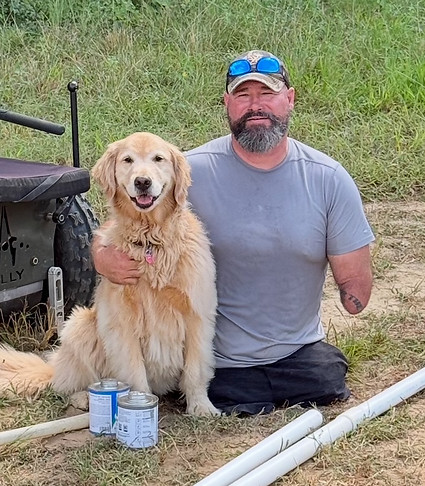
EOD Master Sergeant Joe Deslauriers wears the badge. He is one of them.
Long before September 23rd, 2011, Joe had forged a reputation for level-headedness and calm, gifted at his trade, EOD. In Afghanistan, late on that September Friday morning, Joe and his EOD team, part of a large Marine Corps convoy, entered a killing field seeded with IEDs, plenty of them. Two up-armored trucks, MRAPs, had already been blown up. The convoy halted. Marines went tactical. Medevacs were called in, and the injured were taken away.
Joe and the EOD team would be tasked with clearing the area. Joe took the lead, keeping the other two members of the EOD team close to their MRAP. Marines, gone tactical, waited outside their trucks. Joe began a sweep, listening for the warning signal of the minehound he held, the military version of a metal detector, the long-handled tool that aging men with suntanned pot bellies use to search beaches everywhere, listening for the signal that might reveal a diamond ring lost in the sand, usually only finding some loose change. Joe filtered the information from the mindhound, relying on what he heard to uncover the hidden IEDs and clear a path. He’d done it before, this lethal shuffle through the dirt, moon dust, soldiers call it, powdery, and inches deep.
He went about his business calmly, methodically, risking his life to protect the lives of others, working alone, the solitude heavy with danger. Caution had a hold on him, slowing him, eclipsing his natural instinct to hurry, an instinct that had been trained out of him. It came as no surprise to those who knew him best that Joe would be the one to take the lead. And it was no surprise that Joe would put the safety of others above his own. That’s who he is.
——————
Joe Deslauriers grew up in small-town America, Bellingham, Massachusetts, to a working-class family. Grandfathers fought in WWII, Uncles in Vietnam. Even at an early age, Joe often accompanied his firefighter father to the firehouse. The fellowship of firefighters, the camaraderie, the friendships he formed with the sons of the other firefighters, and the life of service to others, firefighters willing to put their lives on the line to save others, all of that shaped Joe into the man he became. That and sports, where learning to be part of something outside of yourself, influenced Joe, too.
Bellingham is known for producing good baseball, softball, and football teams, tough and proud, territorial, too. Fierce rivalries with surrounding towns, wars really, sometimes spilled off the field. Teams disliked each other, took winning and losing personally.
By his eleventh birthday, Joe convinced his parents to let him play full-contact Pop Warner Football. In high school, at 6’1’ Joe played wide receiver. Football gave him a sense of belonging. He made more friends, learned the value of teamwork, and became a part of something bigger than himself.
In Joe’s senior year, Bellingham, on the cusp of a season that would propel them past the regular season and into regional high school tournament play, found itself facing the neighboring town high school team, Westwood High School. Bellingham, for as far back as anyone could remember, had never won a game against Westwood, and Westwood was undefeated coming into the game.
Westwood took the field, cocky, arrogant, taunting Bellingham with insults. For two quarters, the teams battled back and forth. At halftime, Westwood held the lead by just three points. Something changed at the start of the third quarter. Bellingham scored quickly, then took the ball over on downs, and scored easily again.
On a routine quick out, what was supposed to be just a quick pass and catch, maybe gain a few yards, Joe snatched the ball out of the air, sidestepped a would-be Westwood tackler, and ripped off 64 yards. A sudden muscle spasm flashed through his leg. Determined to leave it all on the field, Joe kept going, hopping for several more yards. Keep going, keep running. I can get there. And he almost did, but slowed by the cramp, he was caught from behind and tackled on the one-yard line. On the sideline, he watched a teammate bulldoze into the end zone. For him, it wasn’t so much about being the guy who scored as much as it was about being part of the team, contributing, not quitting, and fighting through the pain. That was his job. Bellingham won by eight touchdowns.
After high school, Joe tried college, but his heart wasn’t in it. He’d always believed that he would be a firefighter like his father; the lure of the brotherhood called to him. But if not a firefighter, then certainly some other first responder profession; the military might even be an option. Uncles who had served in Vietnam, one who’d become an officer, influenced Joe. Just a few days after leaving college, Joe went to the Marine Corps Recruiting office. He had a plan. The military had the training he’d need to become a firefighter. Joe’s problem? He might have been more than honest, noting on the application that asthma ran in the family. Even though he was fairly certain that he did not have asthma, the Marine Corps recruiter said the possibility would disqualify him. “However,” said the recruiter. “Can I give you some advice?”
“Yes, Sir,” Joe said, making the Marine Corps recruiter wish he’d hadn’t checked that box, the one about asthma. I mean, come on, the kid is already putting a ‘yes, sir’ on everything. Well-mannered, Joe was a recruiter’s dream candidate. It didn’t hurt, too, that Joe was six foot one, lean and muscled.
“Try another branch; they all have offices in the building, and remember,” he said with a wink, “You don’t have asthma.”
Joe sounded off with another yes, sir, smiled, did an about-face, and walked across the hall into the Air Force recruiter’s office, leaving the Marine Corps recruiter sadly shaking his head, and Joe’s plan still alive, almost. “There’s a six-month wait on open billets for firefighter school,” The Air Force recruiter said. “If you want to enlist now, there are immediate openings in EOD, which is what civilians think of as the bomb squad. You interested?”
“Yes, Sir, I am.”
Thirteen years later, while convoy trucks idled, gas hogs guzzling up diesel, their rhythmic clatter and unmistakable knocking were the only sounds that filled the otherwise silent afternoon. When a third MRAP moved to the front of the convoy and struck another IED, Joe had seen enough. He radioed the convoy commander, had him order all the vehicles to stay put, and had everyone — the Marines who’d gone tactical, medical personnel, too, to return to their vehicles. Looking for a trail of wire buried in the dirt, he’d already found one trail of wire that had led to a command detonator; Joe had handed his minehound to a Marine while he searched the ground for the wire. When the Marine, carrying Joe’s minehound, was ordered to return to the safety of the vehicles, he tossed the minehound to the ground and hurried back to the safety of a waiting MRAP.
A modified Abrams tank, fitted with long metal tines to clear the ground in front of it, rolled in front of the convoy. The tines plowed through the dirt, striking an IED packed with enough explosive to disable the Abrams. Joe, believing that the IED might have been another that was tethered to a command detonator, the first IED had been wired to a command detonator, a waiting Taliban at its end, picked up the discarded minehound and walked back to the truck for more equipment. Needing more tools, he made two or three trips back to the truck, using the minehound that the Marine had left behind. He swept the heavily booby-trapped area. Every move held the possibility of turning wrong in an instant. Joe believed that the minehound he carried was fully functional. It wasn’t. Damaged when it struck the ground, it failed to give off the warning signals. Even though Joe had walked the same path several times, using the broken minehound, his steps just inches away from undetected IEDs had miraculously slipped by the buried bombs, the ones the minehound hadn’t warned him of.
What happened next was like a choreographed scene from a movie, a bad movie, the millisecond of silence, the flash of light, the cloud of dust and debris rising, before the deafening roar of the explosion, the rush of air sucked into a vacuum, and then the blast, a supersonic blast that threw Joe into the sky, before slamming him into the ground. Joe somehow clung to consciousness. The blast deafened him, then a hollow, echoing ring filled his ears. Dirt filled his mouth, choking him. The blow to his body, like being hit with the largest sledgehammer in the world, bludgeoned his lungs and made him gasp for breath.
His first thought, “Damit, I just got blown up!”
Joe found himself lying on his stomach in the blast crater. Through the dust cloud, he could see his left arm, all red and splinters of something jagged and white. He didn’t know, didn’t realize that he was looking at the ripped flesh and torn bone that had been his arm. He didn’t feel any pain, not yet. That would come as the adrenaline waned and shock subsided. Joe had no idea of the extent of his injuries.
Disobeying the Marine Corps leader’s order to stay in the vehicles, Joe’s EOD teammates and a corpsman bolted from their truck and rushed to Joe. They rolled him over and began emergency battlefield first aid. The sun at its high point in the sky, and the settling dust blinded Joe. He wanted to see the extent of his injuries, tried to sit up. “Don’t! Don’t try to sit up. No!” someone shouted. Joe could see his right arm. Could move it. The corpsman tightened a tourniquet above the wound that had severed his left arm, trying desperately to stop the bleeding. Pain radiated through what was left of Joe’s arm like fire; that’s what a tourniquet will do to you. He felt them cutting away what was left of his uniform, tightening tourniquets on both his legs. “Let me sit up,” he said, “I want to see what this explosion has done to me.”
“Lie still. Just lie still. We’re working on you.”
A sleeping numbness spread through Joe. Suddenly tired, bone weary, it’s the loss of blood, wanting nothing more than to go to sleep, Joe closed his eyes. Silence. Darkness.
“No. No. No!” someone shouted, jarring Joe awake. Don’t you dare fall asleep on me. You stay with me. Talk to me. Tell me about the baby that’s coming, c’mon, Joe. Boy or girl? You’ve never said.”
Joe looked up. “Shut the f--- up,” he said. “You think I don’t know what you guys are trying to do? Stop.”
But the men intent on saving their friend’s life wouldn’t stop, didn’t stop, weren’t about to let Joe slip into unconsciousness, a coma, something that he almost certainly would not have woken from. They kept him conscious, doing their job right, doing everything they could to keep Joe alive. Between their refusal to let him slip away, the tourniquets and bandages, and coagulants, too, they bought him time.
Joe heard them on the radio, calling in the medevac. The wait, only minutes, felt like an eternity. Joe had been on the other side of this too many times. He understood the “Golden Hour,” the critical period of time that someone like him, limbs ripped from his body and serious blood loss, had to live without major life-saving medical treatment.
“Okay,” someone said. “The medevac is here. We are going to carry you over now. It’s a Brit helicopter, the closest one available. Say goodbye to your guys.”
“Thanks, guys, I’ll —
In the middle of his goodbyes, Joe was loaded onto the medevac. A doctor and nurse, part of the medevac team, began immediate life-saving treatments. They started an I.V., something for the pain. A warmth flowed through him. Joe felt himself slipping away, unable to fight, suddenly feeling safe and in good hands, he let go. The explosion had torn off his left arm and ripped off both legs. But Joe was alive. Five days later, Joe woke up at Walter Reed.
DONATE
WE CAN MAKE A DIFFERENCE,
AND YOU CAN HELP.
This is an all-volunteer effort. If you are interested in additional information, to donate, become a sponsor, volunteer, or to secure a team spot in the next tournament, please contact Bob Vitale, President and Event Chairman at sticksforsoldiers@gmail.com.
Donations may be sent to:
Sticks for Soldiers, Inc.
c/o Treasurer
PO Box 475
Fairfield, CT 06824-0475
Checks made payable to:
Sticks for Soldiers, Inc.
Memo note: 2026 S4S
Sticks for Soldiers, Inc. is a 501(c)(3) tax exempt organization recognized by the IRS.
EIN #: 46-0962202
STAY CONNECTED
DONORS & SPONSORS


Sticks For Soldiers is a non-profit charity lacrosse tournament held in Fairfield, CT to raise money for wounded troops. The mission of the tournament is to provide support and give thanks to the service men and women who put their lives on the line and sacrificed for our country, while raising awareness among high school athletes to the sacrifices being made by people just a few years older than they are. The event and related fund-raising efforts has now raised over $1,200,000 in 17 years.